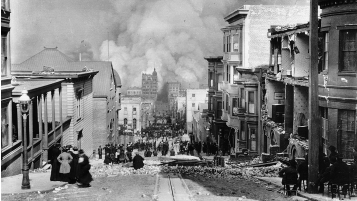
April 18 marks 120 years since the earthquake that nearly wiped San Francisco from the map. At 5:12 a.m. on that morning in 1906, a magnitude 7.9 earthquake tore along almost 300 miles of the San Andreas Fault, shaking the city for nearly a minute straight.
Over 8,000 people died, more than 80 percent of San Francisco was reduced to rubble, and 28,000 buildings collapsed.
And that destruction was all before the fires started. Broken water pipes made the flames impossible to put out, and the city burned for four days. Most historians agree the fire killed more people and destroyed more property than the shaking. When the shaking and the fires were over, much of the city was gone.
To combat looting and lawlessness in the chaos after the earthquake, Mayor Eugene Schmitz granted police permission to shoot anyone caught committing certain crimes on sight. Around 300 alleged looters were shot in the days that followed, but historians now speculate that many were just residents searching the rubble for food and other belongings.
Walking around the city today, it’s hard to imagine. “The City recovered so quickly because it had to,” said Susan Sutton, San Francisco Stories teacher.
She continued. “Newspapers around the world published headlines saying that ‘San Francisco was destroyed’ or ‘completely gone.’ Obviously, this wasn’t true, but we needed to prove that to the world. In many ways, that exemplified our city’s symbol, a phoenix rising from the ashes.” Coffee shops, MUNI stations, the downtown skyline, was all built on ground that was once rubble and ash. There’s almost no physical trace left of the disaster now. The city was rebuilt so completely and so fast that the disaster sometimes feels more like a legend than history.
The City took the destruction and pain and seized the opportunity to rebuild smarter. Archbishop Patrick Riordan, who led the Archdiocese of San Francisco at the time, announced with that spirit: “I am a citizen of no mean city. We will rebuild.”
A dedicated emergency firefighting water system with 135 miles of underground pipes was completed in 1913, designed specifically because the broken mains had made the fires unstoppable.
With modern science and technology, scientists also learned a significant amount about earthquakes. Today, seismic sensors are embedded across the Bay Area, early warning systems can alert residents seconds before shaking arrives, and building codes have been rewritten around what 1906 taught us; we know more about what’s under our feet than any generation before.
According to the U.S. Geological Survey, “The real threat to the San Francisco Bay region over the next 30 years comes not from a 1906-type earthquake, but from smaller (magnitude about 7) earthquakes occurring on the Hayward fault, the Peninsula segment of the San Andreas fault, or the Rodgers Creek fault.”
But knowing more about earthquakes doesn’t make the risk disappear, and seismologists have stayed consistent for decades that a major earthquake hitting the Bay Area is a matter of when, not if. Every small shake is a reminder of that, whether we want it to be or not