
In 1956, artificial intelligence was created. Today, 69 years later, thousands of workers are being laid off from their jobs every week–if not daily–due to AI. With its rise in popularity and development, the spread of business changes and new AI software is prevalent throughout the business industry. What will our world look like in the foreseeable future with AI?
Without AI, tasks done by humans could take minutes, hours, or days–but now, they can be done by AI software in seconds.
Research before the common use of AI was much different. Math for Business teacher Mary Ann Datoc said, “[there were] definitely a lot of trips to the library. Using the library index to find archives, using the computer to find articles for research, reading newspapers, looking at trends for stock markets, a lot of word of mouth— talking to people that were more knowledgeable of the businesses.”
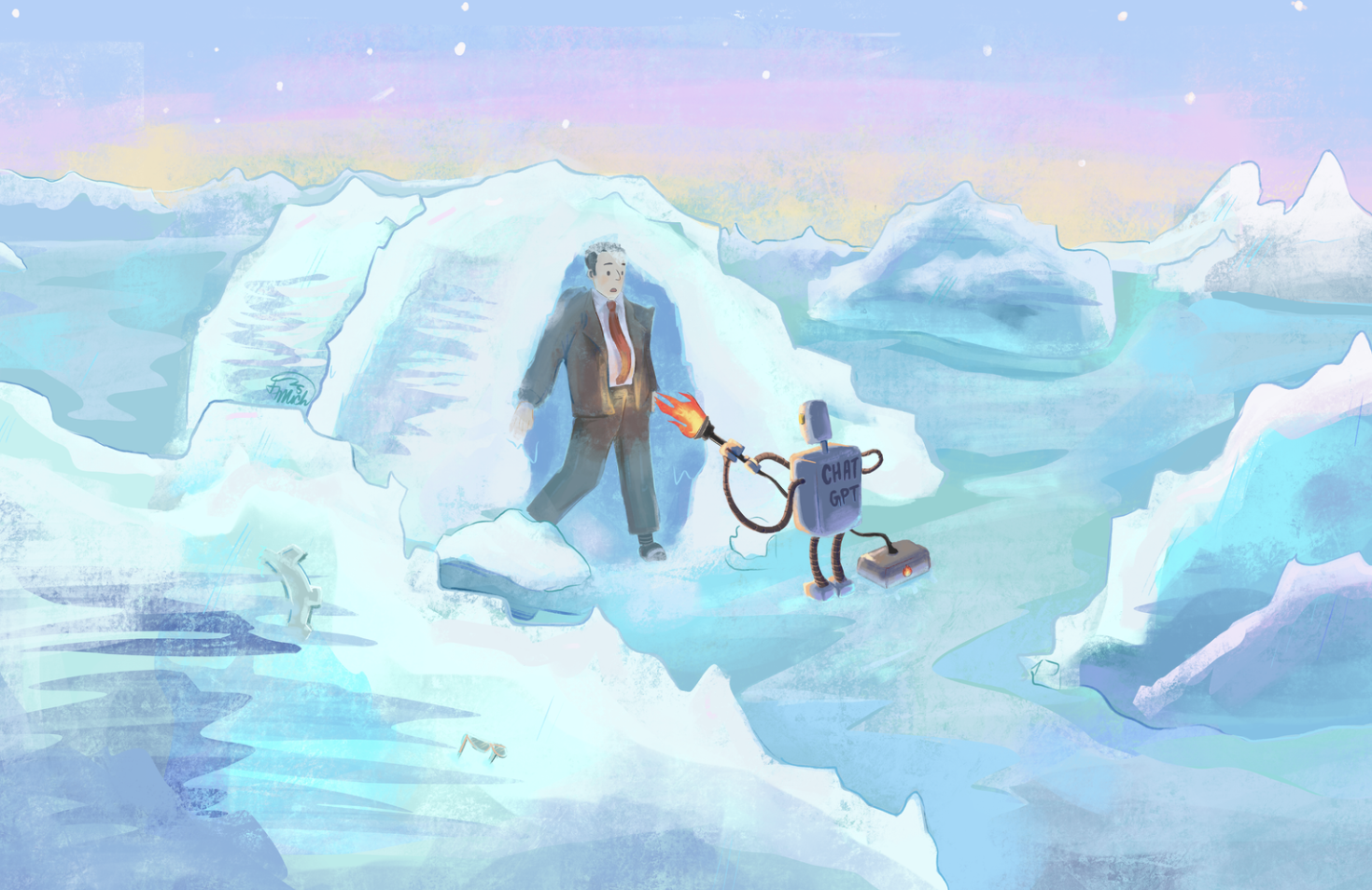
The rise of AI has had a chilling effect on some professions, icing out jobs that computers and robots can accomplish more efficiently.
Data and analytics no longer have to be done manually, but can simply be plugged into AI, creating data-sets, analysis, and processing algorithms quicker than ever before.
Companies such as Open AI (Chat GPT, Sora AI, Dall-E), Google (Gemini), Apple (Apple AI), Microsoft (Copilot), and Meta are some of the biggest brands in the AI industry, becoming a household name because of their popularity. AI has become a powerhouse in terms of its ability to quickly translate, analyze, create, design, and process information with profound speed, eliminating the need to have human employment.
When asked about the future emphasis on AI-centered businesses, US Government/ Economy teacher Brian Morgan commented, “They once used [searched on] Google, but they now type it into ChatGPT. I think the companies that are on the front end of this, who have the mindset of ‘This is new, let’s use it. And, let’s utilize it for profit,’ and they have the financial backing to create this kind of internal chatbot and help–I think that it’s going to continue.”
With AI, there are several positives, all resulting in quicker, efficient, thorough work.
Business program teacher Grace Ingersoll said AI has an advantage over humans with, “Speed. We don’t function the same way as with a word processor or excel, so there’s a huge advantage.”
Ingersoll added, “The human brain has experiences and education at their fingertips. With AI, when you give them certain materials, they have all of that information to go off of at an ultrafast speed with certain tasks.”
The human labor needed for hours of manual work and tedious tasks is unneeded with AI, along with having to disperse wages. With the rise of AI, workforces are now laying off employees in order to create more budget for AI, with companies such as Amazon, Salesforce, Chegg, and Lufthansa laying off thousands of employees.
With this rise in lay-offs due to AI, it has not only caught the attention of the public eye, but also the legal eye of politicians, with Senators Mark Warner, D-Va and Josh Hawley, R-Mo, proposing bipartisan legislation to reveal the number of jobs lost due to AI in their AI-Related Job Impacts Clarity Act.
“I do think there’s a difference between having your job replaced in business with AI versus people who don’t use AI,” said Morgan.
This act would require the reporting of AI-related layoffs to the Department of Labor (DOL) from major companies in order to show how AI is impacting the workforce. If this act were to be instated, it could allow for a clearer view and understanding of how AI is being used.
Ingersoll commented, “The reason they’re so okay with letting go and leaning out their workforce is because even if their service gets worse, we’re not gonna stop using them. They’re oligopolies, we rely on them as consumers.”
But what does this rise of AI do for the future of the human workforce? The touch of humanity– care, keen-eye detail? What will happen to craftsmanship–as AI may not replace it, but could possibly dim its light as it creates its own work.
English teacher Kevin Estrada ’00 said, “The human experience is valuable. You can’t replicate that. When there’s human experience, you’re not replicating or emulating anything, it’s so genuine. AI can’t replace that.”
With hundreds of thousands of users using AI every day, from the work force, school, everyday life, and more, the future of AI is one that will–most likely–not diminish.
With time, AI will continue to become the main surface or platform of certain jobs. But, as businesses transform to be centered around AI, or be built off of it, the key factor to all of this is the willingness to keep humanity harmonious with it.