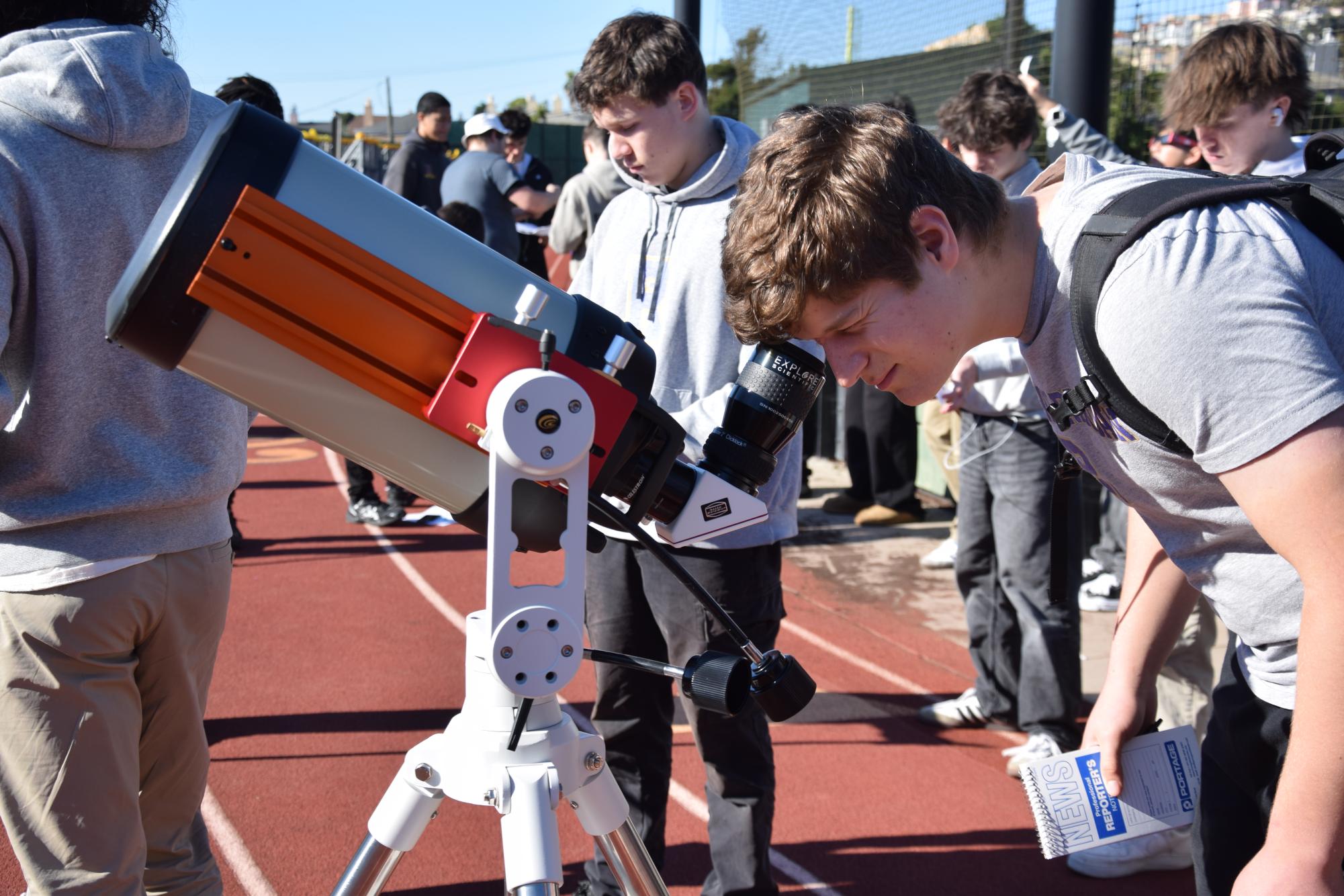
In the eyes of a telescope, the sun erupts, crashing into itself. Huge explosions appear, lighting up the surface of the sun. The phenomenon is known as the solar flare, and is also what the Earth and Space Sciences classes witnessed early January this year.
“For our first unit, we are looking at galaxies and stars out in space,” said Aaron McCray- Goldsmith, instructor of the course. “It was the first week of school, so I wanted to get the students excited for it.”
The class set up on the Mayer Family Field, bringing two telescopes with them. The first telescope had a standard lens, cutting out light so students could view the face of the star, shining a bright white.
On the other hand, the H-alpha telescope’s unique light-cutting and lens allowed the students to see the sun in a higher resolution. With its 656.2 nanometer light wavelength, the telescope is able to match the wavelength of hydrogen on the sun, showing much greater detail by directly looking at the features and movement of the star.
This included occurrences like Prominence, where pieces of the sun would get spit off and fall back into the body of the star.
“With the right tools to cut out other light, we can really see some fascinating stuff, getting them excited and introducing some spectrography,” explained McCray-Goldsmith.
Sean Dowd ’27, who used these telescopes, said, “It was all very specific, fascinating, and fun. When we were looking at the solar flares, I was thinking of how that is really the sun that we see every day and how it looks red through a telescope.”
Currently the sun is reaching the end of its 11-year cycle, known as the Solar Maximum, where solar flares events peak.
On Jan. 22, the largest solar flare in the last 20 years was reported. Some of the bigger solar flares that happen around this time can have huge effects on Earth, including satellite interference, radiation, and worldwide blackouts.
However, they also cause large aurora borealis events, making them a spectacle to watch.
“It’s a low probability event, but not as low as getting hit by an asteroid. It’s just one of the things you gotta deal with when you live close to a star. Hoping for just auroras, that’s all we need,” joked McCray-Goldsmith.
Overall, the event was a great learning experience for the students, and it may be the last chance to see solar flares like this in the next few years.
Braydon Dizon ’27 commented, “The sun isn’t even that far from us in comparison to some other planets/galaxies. We are so small compared to the entire universe.”