California is widely known for its natural beauty, diversity, and vibrancy. From its rocky coasts, vast forests, and expansive deserts, to the snow-topped mountains and wide central valleys, it is widely regarded as a pristine haven where nature blooms in its most breathtaking forms.
However, certain regions, such as the Bay Area, have recently reflected broader concerns about species that pose alarming possibilities, most notably regarding birds.
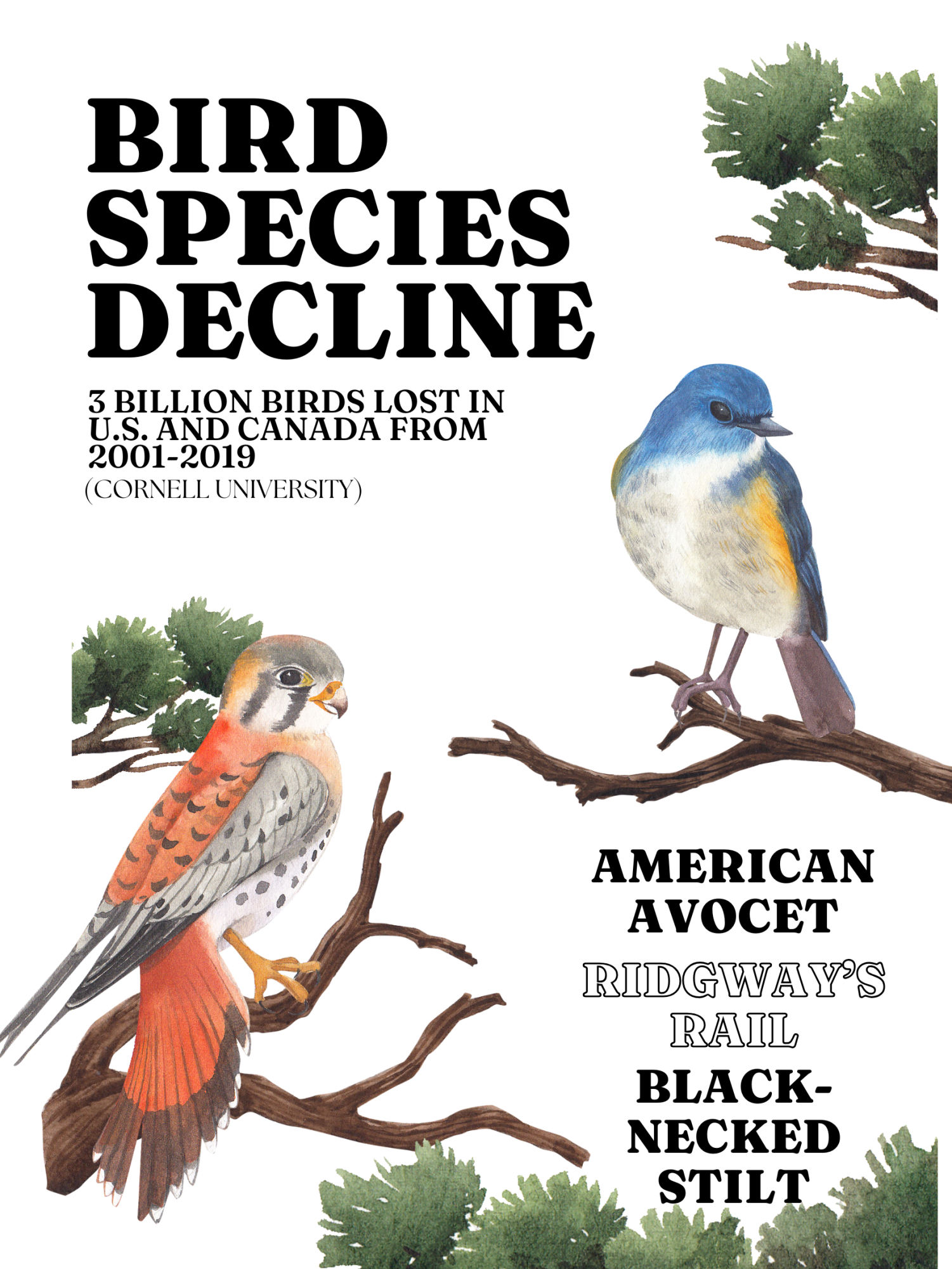
Major large bird species including Bay Area shorebirds, breeding populations, and the Ridgway’s Rail, a gray 14 inch long marshbird, are decreasing as of 2026. In fact, this has been a pattern over several decades.
In a study published by the United States Geological Survey on Sept. 1, 2021, breeding waterbird populations, such as the American Avocet, a large orange and black bird with a long upturned black beak, and the Black-necked Stilt, a black and white bird with long red legs and a straight black bill, have declined from 13 percent to 30 percent over an 18 year period of 2001 to 2019.
Potential causes according to the United States Geological Survey include, “Loss of island nesting habitat as a result of tidal marsh conversion and an increasing population of predatory California Gulls…”
The American Avocet remains the species with the most dramatic observable drop, declining annually by 10 percent, as attributed by SFGate to Matt Reiter.
Other shorebird species including the Dunlin and Willet are declining yearly from 5-8 percent, and the Ridgway’s Rail, found in the salt ponds and marshes of the Bay, has undergone drastic endangerment over the century, most notably due to habitat loss and destruction.
All of these statistics pertaining to the state of biodiversity in the Bay Area are shocking on their own, however, this is only a small factor in a larger global pattern.
Climate change has had negative effects on all aspects of the environment, and the inner workings of our ecosystems. Many have been noticing increasingly the impacts it has had on our own backyard.
Kaia Burris ’27 commented, “It’s really concerning to see how much bird populations in the Bay Area have declined over time, and noticing the observable drop. Knowing the extent of this issue and how long it’s been going on really makes it feel like something we should be paying more attention to.”
According to a study published in Science Daily by Cornell University in 2019, the United States and Canada have lost an astounding 3 billion birds, approximately 1 in 4, since 1970.
Many view this as an ecological emergency, which causes reflection upon potential contributing factors.
“There are lots of ways that humans impact the community of our local ecosystem. The more we develop urban areas, the more habitats are removed and food availability lessened. Pesticides are consumed by insects and affect species up the food chain, potentially birds, as well.” stated science teacher Jack Reardon.
As common Bay Area bird species continue to suffer, it is worth noting harmful habits within communities that lead to decline of species in the ecosystem. Regarding birds, sprawling urban development, use of plastics, and use of pesticides all greatly contribute to this damage.
While living within large communities can often obstruct the visibility of nature, people must remember that each action performed in local communities directly impacts the environment. Even if people don’t see the instant consequences of human activity, protecting the environment is crucial to the maintenance of Earth.