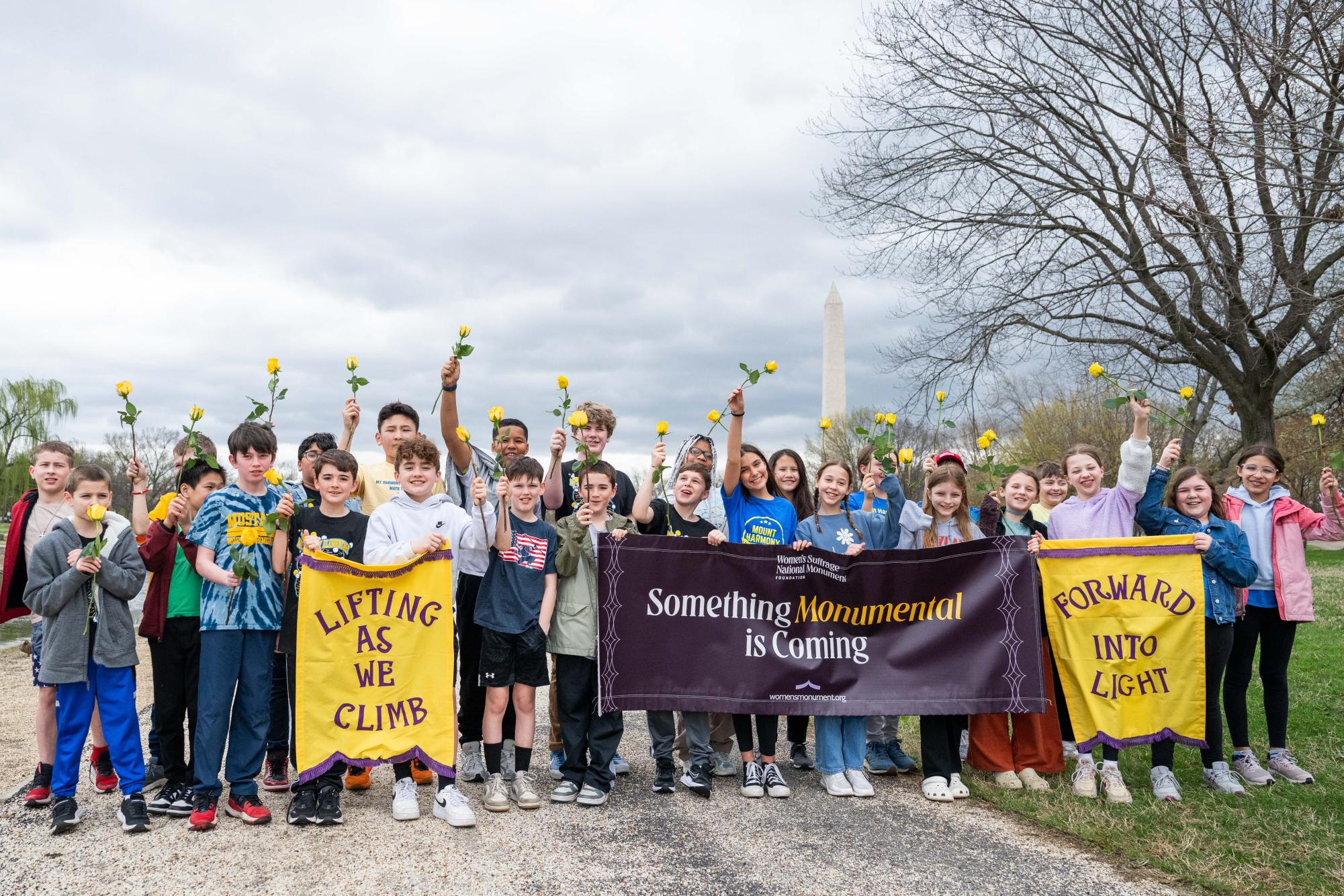
The Lincoln Memorial, Washington Monument, and Jefferson Memorial are all examples of monuments on the National Mall in Washington, D.C., which contain diverse emblems of historical significance.
However, there is one aspect of American history noticeably absent: there are no current monuments exclusively dedicated to the representation of women’s history. That is something the Women’s Suffrage National Monument Foundation is currently aiming to change.
The Women’s Suffrage National Monument Foundation, a nonpartisan organization, is dedicated to honoring the legacy of the suffrage movement in America through the creation of a monument on the National Mall. Led by President and Chief Executive Officer Anna Laymon, the foundation combines the influence of a multitude of women. Every living first lady currently holds a title of honorary chair.
Still steadily underway, the process of bringing the monument to life has been an extensive one. On Dec. 17, 2020, Public Law 116-217 was signed by President Donald Trump, charging the monument to be built, with unanimous bipartisan support from Congress. On Dec. 20, 2024, the monument was authorized to be built on the National Mall.
The monument will be located within the Constitution Gardens, on a 2.5 acre site, and is set to be finished in 2033.
This monument aims to champion the women and suffragists who have forged the path for democracy in America, particularly those who’ve been pushed to the sidelines.
While many are aware of the significant contributions by prominent female figures in American history, representation is often skewed, and gaps still remain in the perception of it.
For instance, influential political movements such as nonviolent resistance, the origin of which is often attributed to male leaders, have actually had their roots with female leaders such as Elizabeth Cady Stanton and Lucretia Mott, who led the Seneca Falls Convention of 1848.
“Women have been the backbone of many historical developments, more so than we’re aware of, because history has commonly been portrayed in a male-centered light,” said Kaia Burris ’27.
Many are aware of the fundamentals of the suffrage movement, such as the ratification of the 19th Amendment, which officially prohibited sex-based discrimination in voting.
However, stories of the women who’ve paved the way and who’ve been the backbone of such movements are still lacking in representation, and many of their stories have been lost in the footnotes of history.
“I think what’s really inspiring is that the engine of the suffrage movement was the thousands of women whose names will never appear in a textbook… They were everyday mothers, teachers, neighbors, who through conversations on their front porches or in women’s clubs, changed minds, and they did the invisible work.” commented Vice President of Communications Amanda Hunter.
In creating the first monument on the National Mall to honor these countless women throughout history who have tirelessly worked toward a future full of opportunities, the foundation not only propels these stories into the public eye, but creates an environment where young girls see themselves in positions of power, influence, and change.
English teacher Beth Fergus stated, “Preserving women’s history through monuments, archives, museums, oral histories, and curricula serves several purposes. It corrects the historical record, making it more accurate and complete. It provides future generations with a fuller understanding of how the country was actually built. It creates a sense of belonging, legitimacy, and pride for women and girls who see themselves represented.”
A unique aspect of this monument in particular is the inclusion of voices across the country, as the foundation is currently accepting submissions regarding ideas for the construction of the monument. An integral part of the foundation’s mission is to champion the voices of women throughout history, but also to shape the voices of future generations through direct contributions to this historical feat.
“Shirley Chisholm once said that if they don’t give you a seat at the table, bring a folding chair,” said Hunter, “And so, the lesson of this monument for the next generation is that if there isn’t a monument there, you secure the land, and if the history isn’t written, you write it yourself… progress is not a given.”